Gender social stereotypes are one of the main causes of bullying experienced by girls.
Sep 26, 2023
Gender social stereotypes are one of the main causes of bullying experienced by girls.
Sep 26, 2023
According to a UNICEF report, the highest percentage of bullying victims are girls, due to mockery about their physical appearance and cyberbullying.
What may seem like a simple routine going to school is, for some, the worst part of the week. This is the reality faced by seven out of ten children, who deal daily with situations of bullying or cyberbullying, according to the First Global Report on Bullying by the NGO Bullying Without Borders. One of the most affected groups is young women, as UNICEF points out, they account for the highest percentage of victims. An example is Paula, who shared that “thinking every night about going back to school the next day was terrifying,” as she replayed in her mind the comments her classmates made about her physical appearance. But Paula is just the reflection of hundreds of young people.
Gender social stereotypes are shaped by the culture in which we grow up, though there is ongoing effort to deconstruct them. A study by the Institute for Women concludes that primary school girls experience aggression rooted in gender expectations and the patriarchal system prevailing in society. This becomes evident when forming friendship groups at school-only those who (luckily) conform to stereotypes are accepted. Young women who don’t fit the beauty standards are more likely to be excluded and are at greater risk of bullying. “Bullying is a very serious issue, and in the end, it can affect anyone,” said psychologist Elena Morales.
Types of school violence
School bullying involves both physical and psychological violence. Until 2019, physical attacks were more common, but everything has now changed, as shown in the 6th Report on School Bullying Prevention by Mutua Madrileña and the ANAR Foundation. Attacks now focus on the victim’s emotional well-being, with 89.5% of cases involving insults, name-calling, and mockery about physical appearance, clothing, or personal behavior. This is often reinforced by social exclusion or the spreading of rumors, which directly impact the victim’s mental stability.
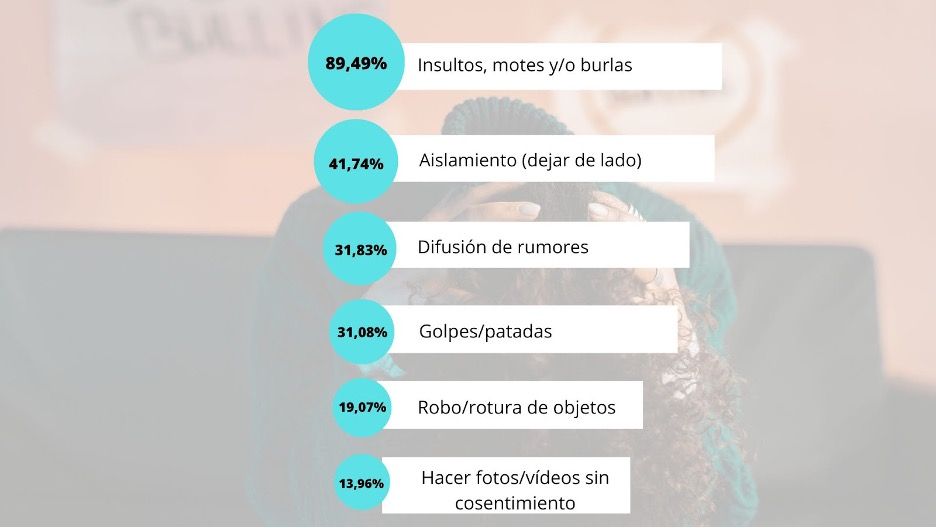
The rise of social media has caused school bullying not to end at the school gates, but to cross into the victims’ own homes. As UNICEF points out in one of its studies, on average two students per classroom suffer from cyberbullying, and 42.6% of young women report having received threats through a screen.
In Spain, as highlighted by the World Health Organization (WHO), it is one of the countries with the highest presence of cyberbullying among girls, with an average age of 13. Many of them have experienced rumors being spread about their lives, insults, or the leaking of private photos and videos. What once happened on WhatsApp now has new enablers like Instagram and TikTok.
The consequences of school bullying
Everyone subjected to this kind of behavior suffers serious harm to their mental health. Psychologist Morales emphasized that, for victims of bullying, “it is a trauma and it breaks their self-concept.” She added that the most common effects while experiencing bullying are anxiety, stress, or depression, and that these effects can last a lifetime. “Each person processes their experience differently, but if you’ve received negative comments about your body, it can lead to long-term consequences such as low self-esteem, feeling undeserving of love, or developing an Eating Disorder (ED),” she explained. Another example she mentioned is social isolation resulting from bullying, which leads to a total loss of social skills. “Having poor social skills when we live in a society and constantly interact leads to a great deal of mental suffering,” she stressed.
On top of all the distress felt by victims of bullying, there is the pressure exerted by the educational system. The mental health expert stated that “schooling can lead to many mental health problems, especially in a society where more and more academic qualifications are required.” The daily workload, the feeling that one exam can determine your future, or that abilities are measured by a grade, all take a toll on the mind. According to Morales, these situations can lead to high levels of perfectionism, make people want to control everything, and significantly reduce their tolerance for frustration. “The educational model pushes many people to be ambitious and feel the need to do many things without knowing how to stop,” she acknowledged.
In the end, living with school bullying and everything it entails causes many individuals to reach the limit and take their own lives. A Save The Children report from early 2022 states that bullying victims are 2.55 times more likely to attempt suicide. The same organization incorporates the gender variable and shows that from age 13 onward, suicidal thoughts are more frequent among girls. To reduce these figures, prevention plans are being developed, but they are often blocked at the political level. In the case of school bullying, protocols have been approved, and each autonomous community in Spain has a response guide, but these are often not implemented. So much so that the ANAR Foundation reports that students themselves believe nearly 48% of bullying cases are never resolved. All this data shows that school bullying is a much deeper issue than what many believe when they say “it’s just kids being kids.” That is why November 5th is observed as the International Day Against Violence and Bullying at School.
Useful links:
6th Report on the Prevention of School Bullying in Educational Centers: https://www.anar.org/repunta-el-acoso-escolar-segun-el-iv-informe-la-opinion-de-los-estudiantes-de-anar-y-mutua-madrilena/
3rd Report by the ANAR Foundation on School Bullying: https://www.anar.org/wp-content/uploads/2021/12/III-Estudio-sobre-acoso-escolar-y-ciberbullying-segu%CC%81n-los-afectados-1.pdf
Report by the Women’s Institute on Violence Against Girls in Primary Education: https://www.inmujeres.gob.es/areasTematicas/
estudios/estudioslinea2009/docs/analisisViolenciaNinas.pdf
UNICEF Report: Children Affected by the Digital Divide in Spain: https://www.unicef.es/publicacion/estado-mundial-de-la-infancia-2018-los-ninos-y-ninas-de-la-brecha-digital
Save the Children Report “Crecer Saludable(mente). Un análisis sobre la salud mental y el suicidio en la infancia y la adolescencia”: https://www.savethechildren.es/sites/default/files/2021-12/Informe_Crecer_saludablemente_DIC_2021.pdf?utm_source=NotaPrensa&utm_medium=referral&utm_campaign=SaludMental
According to a UNICEF report, the highest percentage of bullying victims are girls, due to mockery about their physical appearance and cyberbullying.
What may seem like a simple routine going to school is, for some, the worst part of the week. This is the reality faced by seven out of ten children, who deal daily with situations of bullying or cyberbullying, according to the First Global Report on Bullying by the NGO Bullying Without Borders. One of the most affected groups is young women, as UNICEF points out, they account for the highest percentage of victims. An example is Paula, who shared that “thinking every night about going back to school the next day was terrifying,” as she replayed in her mind the comments her classmates made about her physical appearance. But Paula is just the reflection of hundreds of young people.
Gender social stereotypes are shaped by the culture in which we grow up, though there is ongoing effort to deconstruct them. A study by the Institute for Women concludes that primary school girls experience aggression rooted in gender expectations and the patriarchal system prevailing in society. This becomes evident when forming friendship groups at school-only those who (luckily) conform to stereotypes are accepted. Young women who don’t fit the beauty standards are more likely to be excluded and are at greater risk of bullying. “Bullying is a very serious issue, and in the end, it can affect anyone,” said psychologist Elena Morales.
Types of school violence
School bullying involves both physical and psychological violence. Until 2019, physical attacks were more common, but everything has now changed, as shown in the 6th Report on School Bullying Prevention by Mutua Madrileña and the ANAR Foundation. Attacks now focus on the victim’s emotional well-being, with 89.5% of cases involving insults, name-calling, and mockery about physical appearance, clothing, or personal behavior. This is often reinforced by social exclusion or the spreading of rumors, which directly impact the victim’s mental stability.
The rise of social media has caused school bullying not to end at the school gates, but to cross into the victims’ own homes. As UNICEF points out in one of its studies, on average two students per classroom suffer from cyberbullying, and 42.6% of young women report having received threats through a screen.
In Spain, as highlighted by the World Health Organization (WHO), it is one of the countries with the highest presence of cyberbullying among girls, with an average age of 13. Many of them have experienced rumors being spread about their lives, insults, or the leaking of private photos and videos. What once happened on WhatsApp now has new enablers like Instagram and TikTok.
The consequences of school bullying
Everyone subjected to this kind of behavior suffers serious harm to their mental health. Psychologist Morales emphasized that, for victims of bullying, “it is a trauma and it breaks their self-concept.” She added that the most common effects while experiencing bullying are anxiety, stress, or depression, and that these effects can last a lifetime. “Each person processes their experience differently, but if you’ve received negative comments about your body, it can lead to long-term consequences such as low self-esteem, feeling undeserving of love, or developing an Eating Disorder (ED),” she explained. Another example she mentioned is social isolation resulting from bullying, which leads to a total loss of social skills. “Having poor social skills when we live in a society and constantly interact leads to a great deal of mental suffering,” she stressed.
On top of all the distress felt by victims of bullying, there is the pressure exerted by the educational system. The mental health expert stated that “schooling can lead to many mental health problems, especially in a society where more and more academic qualifications are required.” The daily workload, the feeling that one exam can determine your future, or that abilities are measured by a grade, all take a toll on the mind. According to Morales, these situations can lead to high levels of perfectionism, make people want to control everything, and significantly reduce their tolerance for frustration. “The educational model pushes many people to be ambitious and feel the need to do many things without knowing how to stop,” she acknowledged.
In the end, living with school bullying and everything it entails causes many individuals to reach the limit and take their own lives. A Save The Children report from early 2022 states that bullying victims are 2.55 times more likely to attempt suicide. The same organization incorporates the gender variable and shows that from age 13 onward, suicidal thoughts are more frequent among girls. To reduce these figures, prevention plans are being developed, but they are often blocked at the political level. In the case of school bullying, protocols have been approved, and each autonomous community in Spain has a response guide, but these are often not implemented. So much so that the ANAR Foundation reports that students themselves believe nearly 48% of bullying cases are never resolved. All this data shows that school bullying is a much deeper issue than what many believe when they say “it’s just kids being kids.” That is why November 5th is observed as the International Day Against Violence and Bullying at School.
Useful links:
6th Report on the Prevention of School Bullying in Educational Centers: https://www.anar.org/
3rd Report by the ANAR Foundation on School Bullying: https://www.anar.org/wp-content/uploads/2021/12/III-Estudio-sobre-acoso-escolar-y-ciberbullying-segu%CC%81n-los-afectados-1.pdf
Report by the Women’s Institute on Violence Against Girls in Primary Education: https://www.
inmujeres.gob.es/areasTematicas/
docs/analisisViolenciaNinas.pdf
UNICEF Report: Children Affected by the Digital Divide in Spain: https://www.unicef.es/
publicacion/estado-mundial-de-la-infancia-2018-los-ninos-y-ninas-de-la-brecha-digital
Save the Children Report “Crecer Saludable(mente). Un análisis sobre la salud mental y el suicidio en la infancia y la adolescencia”: https://www.
savethechildren.es/sites/default/files/
2021-12/Informe_Crecer_saludablemente_
DIC_2021.pdf?utm_source=NotaPrensa&utm
=referral&utm_campaign=SaludMental